Lizzian.

Web design + generative engine optimization

Websites built to be found, understood, and trusted.

Lizzian designs fast, distinctive websites with a clear public record of what your business does, where it works, and why it can be trusted—for people, search engines, and AI answers alike.

Independent studio in Boulder, Colorado. No packages or ranking promises. Every engagement starts with a written review of the real site and facts.

01 Readable source HTML

02 Verified business facts

03 Schema that matches

04 Accessible by default

Built for considered decisions

Your website is often the first serious conversation.

We are not an industry specialist and we do not pretend to be. What our clients have in common is that a stranger has to find them, understand them, and act — usually in under a minute, often on a phone, increasingly through a summary written by something that read the site instead of the person.

01

Local and regional services

Contractors, repair and installation trades, cleaning, moving, landscaping, pest control, auto shops. Multiple service areas, seasonal hours, and a phone that has to be findable in one tap.

02

Clinics and practices

Dental, optometry, physical therapy, veterinary, counselling, specialty medical. Provider lists, insurance and intake details, and hours that must not contradict the map listing.

03

Professional firms

Law, accounting, engineering, architecture, consulting, financial services. Practice areas, credentials, jurisdictions, and named people who need to be verifiable.

04

Hospitality and hometown retail

Restaurants, cafés, bars, inns, salons, studios, boutiques, galleries. Menus, bookings, parking, and hours that change more often than anyone remembers to update them.

05

Independent brands

Makers, small labels, publishers, food producers, single-product companies. A site that carries the story and the specifications without depending on a marketplace or a social account.

06

B2B and industrial

Manufacturers, distributors, logistics, SaaS, agencies, labs. Capability lists, certifications, spec sheets, and a route to a human that does not run through a chatbot.

The problem

Three failures cost more than a dated design does.

An out-of-fashion site loses a little credibility. These three lose the enquiry outright, and they are almost always invisible from the inside — the owner already knows the phone number, so the owner never notices it is missing.

  1. The phone problem

    Someone is ready to contact you and cannot. The number sits in the header image, or only in the footer of the desktop layout, or behind a contact form that wants seven fields first. Worse: the site says one number, the map listing says another, and the answering service belongs to whoever bought the old line. Every version of this ends the same way — the caller goes back to the results page and picks the next business down.

  2. The facts problem

    Your hours, address, service area, staff, and what you actually offer are stated in four places and agree in none of them. The site says Tuesday to Saturday, the map profile says Monday to Friday, the booking tool blocks Wednesdays, and a directory from three years ago still lists a suite number you moved out of. Nobody is lying. Nobody is maintaining it either. The customer arrives to a closed door, and the systems that quote your business have no way to decide which version is right.

  3. The extract problem

    A human can read your page; a machine reading the HTML cannot. The menu is a PDF. The service list is baked into a slideshow image. The hours are drawn inside a graphic. The whole page is blank until a script finishes running, and half the content sits inside a third-party widget on someone else’s domain. When a search engine or an assistant tries to extract what you do and where you are, it comes back with your business name and nothing else — so it describes you from whatever it finds elsewhere, which is usually stale, incomplete, or a competitor’s page about you.

A site is not just something to look at. It is the place your business states its own facts, in a form other systems can read without guessing.

What we deliver

A site built so the facts survive the trip.

Every engagement is scoped individually, but the standard we build to does not change.

  • Pages that say what they are about in the first screen

    One clear subject per page, a heading structure that actually describes the content, and the important sentence written before the decorative section — not after it.

  • True facts written in HTML, not in pictures

    Services, hours, locations, staff, credentials, policies, prices you choose to publish, and answers to real questions exist as selectable text in the served HTML. Images and PDFs supplement that text; they never carry it alone.

  • One consistent set of business details

    Name, address, service area, email, and hours are written once, used everywhere, and made to agree with your map listing and directory entries. Where they disagree today, we tell you which is wrong and what to correct.

  • Structured data that matches the page

    Schema.org markup for the organization, locations, services, people, articles, and questions — generated from the same facts the visitor sees. We do not mark up claims that are not on the page, and we do not mark up anything you have not confirmed is true.

  • Fast, accessible, and readable without JavaScript

    Content renders from the HTML. Scripts enhance; they are not a prerequisite for reading the page. Keyboard navigation, colour contrast, focus states, and real form labels are part of the build, not an afterthought.

  • A crawlable, quotable structure

    Clean URLs, one canonical version of each page, a working sitemap and robots file, sensible internal links, correct titles and descriptions, and headings a summariser can follow without inventing the connective tissue.

  • Contact routes that work on the first attempt

    Tappable email and phone links, a form that validates and confirms, an address block that matches your mail, and no dead ends.

  • Handover you can actually use

    Your domain, your hosting account, your content, your files. Plus a short written record of where each fact lives, so the next person to touch the site — us or anyone else — can update it without breaking the consistency.

What we do not claim

We do not promise search rankings, citations in AI answers, traffic volumes, lead counts, or revenue. Nobody can promise those, and the ones who do are describing an outcome they do not control. What we control is the site: whether it is clear, whether the facts are true and consistent, and whether a machine can read them without guessing. That is what we are accountable for.

Pricing

How a quote is formed.

We do not publish packages or a starting price, because the same seven-page site can be a two-week job or a two-month job depending on what already exists. Every project is quoted after we review your current site — or your materials, if there is no site — and see the actual difficulty.

Read the full review and quoting process →

What we look at before quoting

  • Pages. How many, and how many are genuinely different rather than the same template repeated.
  • Content readiness. Whether the text, photos, menus, spec sheets, and staff details exist and are current — or need to be written, gathered, or rewritten.
  • Locations. One address or twelve, and whether each needs its own page, hours, and structured data.
  • Languages. One, or several, and whether translations exist and can be trusted.
  • Integrations. Booking, ordering, payments, scheduling, CRM, inventory, calendars, review platforms — each one is a system with its own rules.
  • How much structure is missing. The largest variable. A site with clean text and wrong markup is quick. A site whose facts live only in images, PDFs, and a page builder’s database is slow, because the facts have to be recovered before anything can be built.

Terms

Scope first
You receive a written scope: pages, deliverables, what is included, what is not, and the schedule. Nothing starts before you accept it.
Deposit
A deposit is due after you accept the written scope. The balance is due before launch.
Ownership
You own the domain and the content. Registrar and hosting accounts are in your name from the start.
Ongoing updates
Optional, quoted separately, and never required to keep the site working. There is no public monthly price for the same reason there is no public build price.

Illustrative scenarios

What the work looks like in practice.

Six composite examples, each shown as a design mockup of an invented business. They are illustrative, not case studies of named clients — and the facts about each one are written as text below the picture, never inside it.

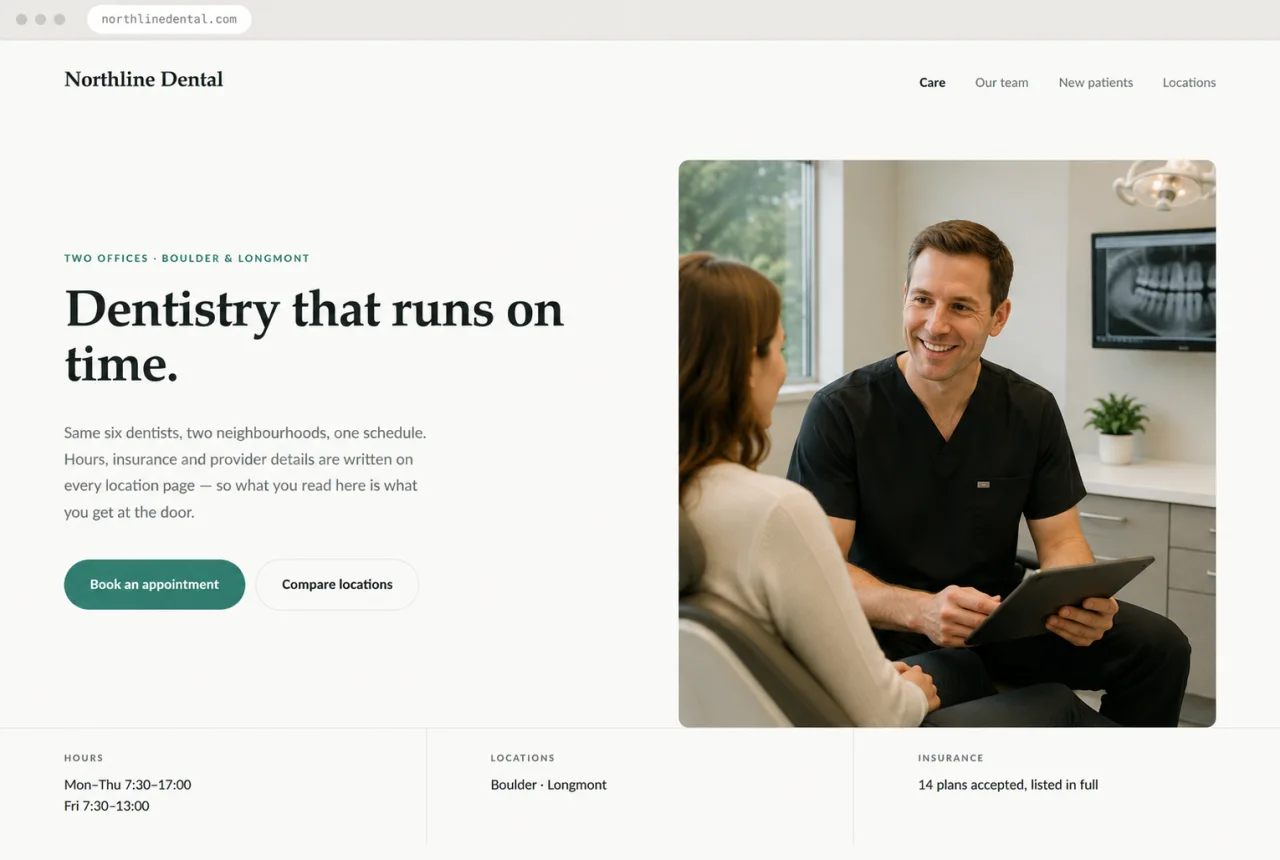
Design mockup of a dental practice website with a dentist consulting a patient, the headline “Dentistry that runs on time”, and visible opening hours, locations and insurance details.
Hypothetical · Dental practice · two locations

Three sets of hours, none of them right

Six providers across two offices. Hours were published in a header graphic, again inside a third-party booking widget, and again on the map listing — all three different after a schedule change nobody propagated. Patients were arriving at a closed office.
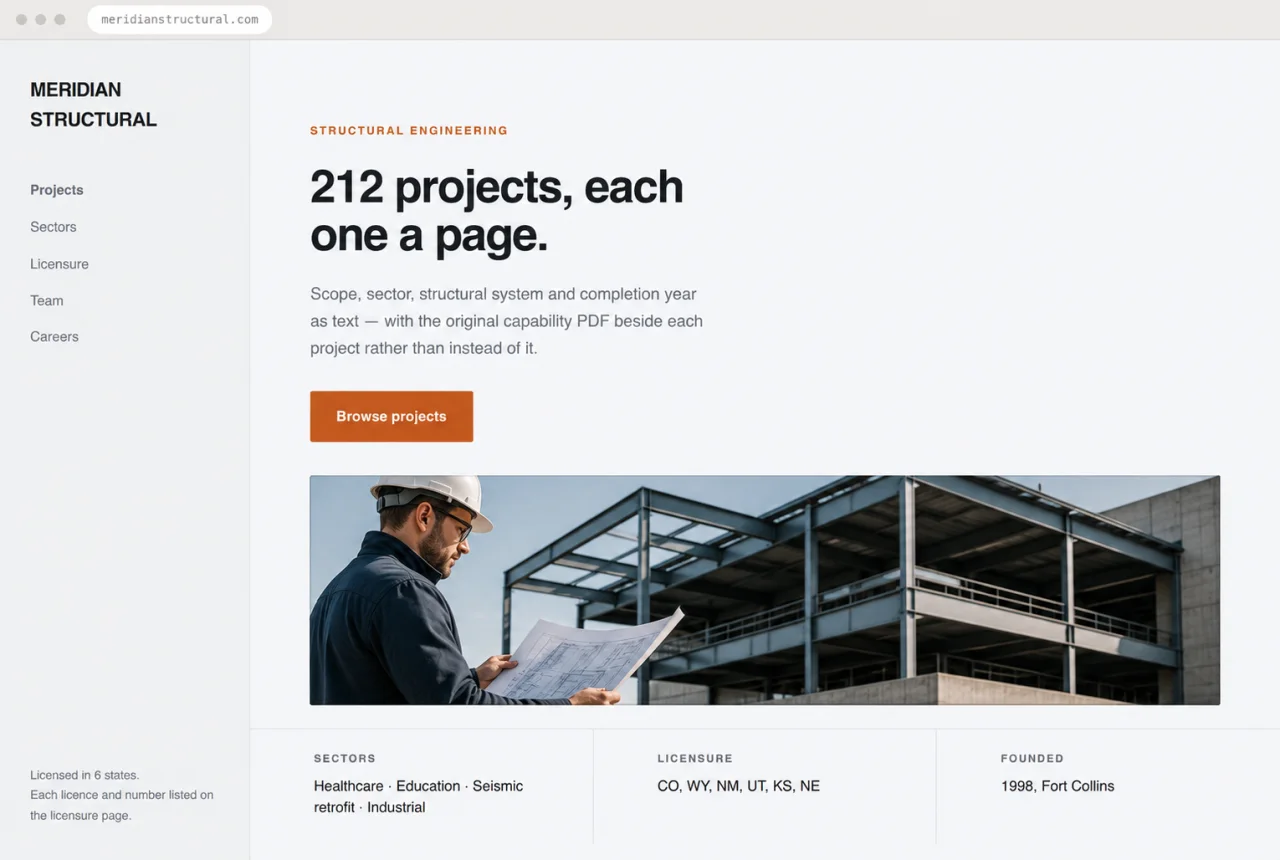
Design mockup of a structural engineering website with an engineer reviewing plans beside a steel structure, the headline “212 projects, each one a page”, and visible licensure details.
Hypothetical · Structural engineering firm

Twenty years of projects, invisible in HTML

Two decades of completed work living entirely inside downloadable capability statements and project PDFs. The site itself was four pages of copy that could have described any engineering firm in the country, and no page said which states the firm was licensed in.

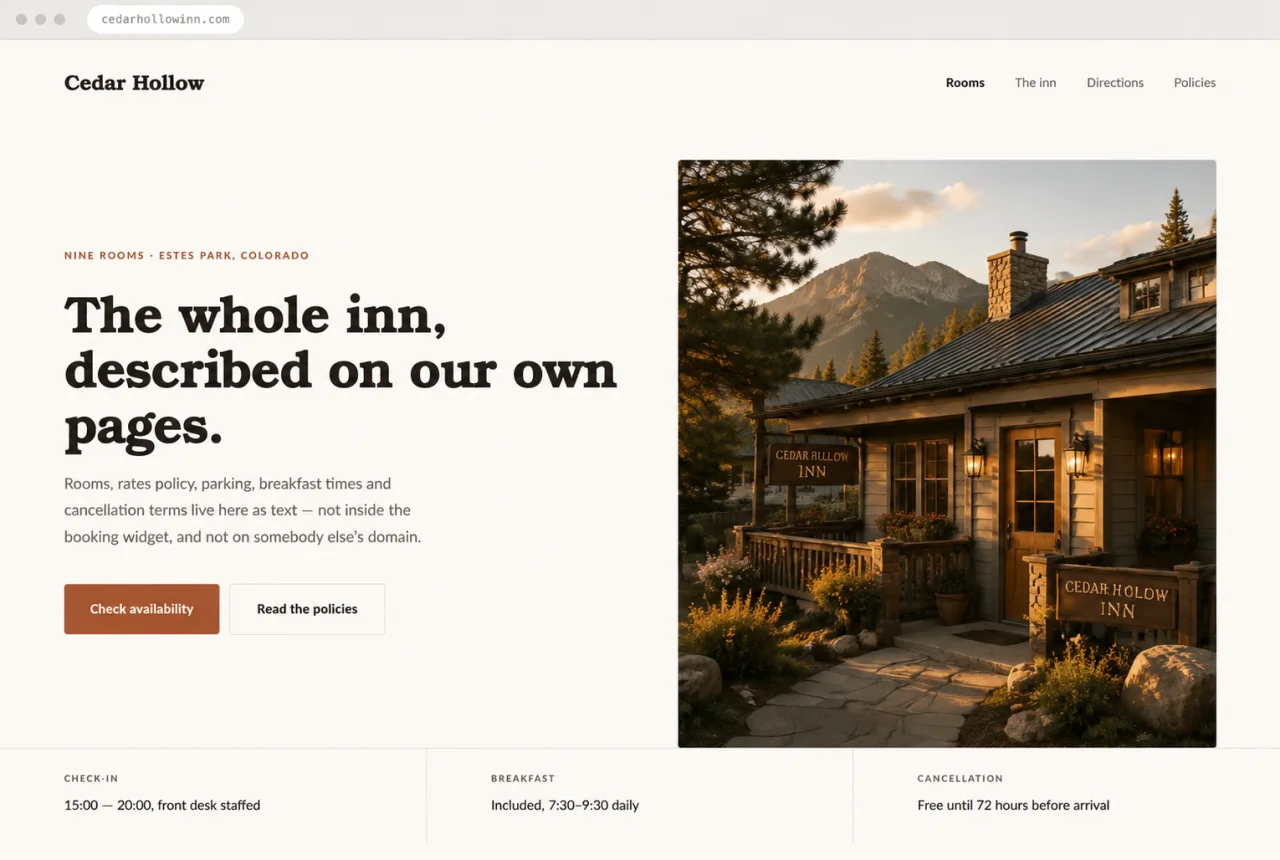
Design mockup of a country inn website with a Colorado mountain inn at golden hour, the headline “The whole inn, described on our own pages”, and visible check-in and cancellation details.
Hypothetical · Independent inn · nine rooms

A booking engine that swallowed the property

The entire site was a JavaScript shell wrapped around a third-party booking engine. Room descriptions, photographs, the cancellation policy and even the street address lived on the vendor's domain. With scripts blocked, the inn's homepage was blank.

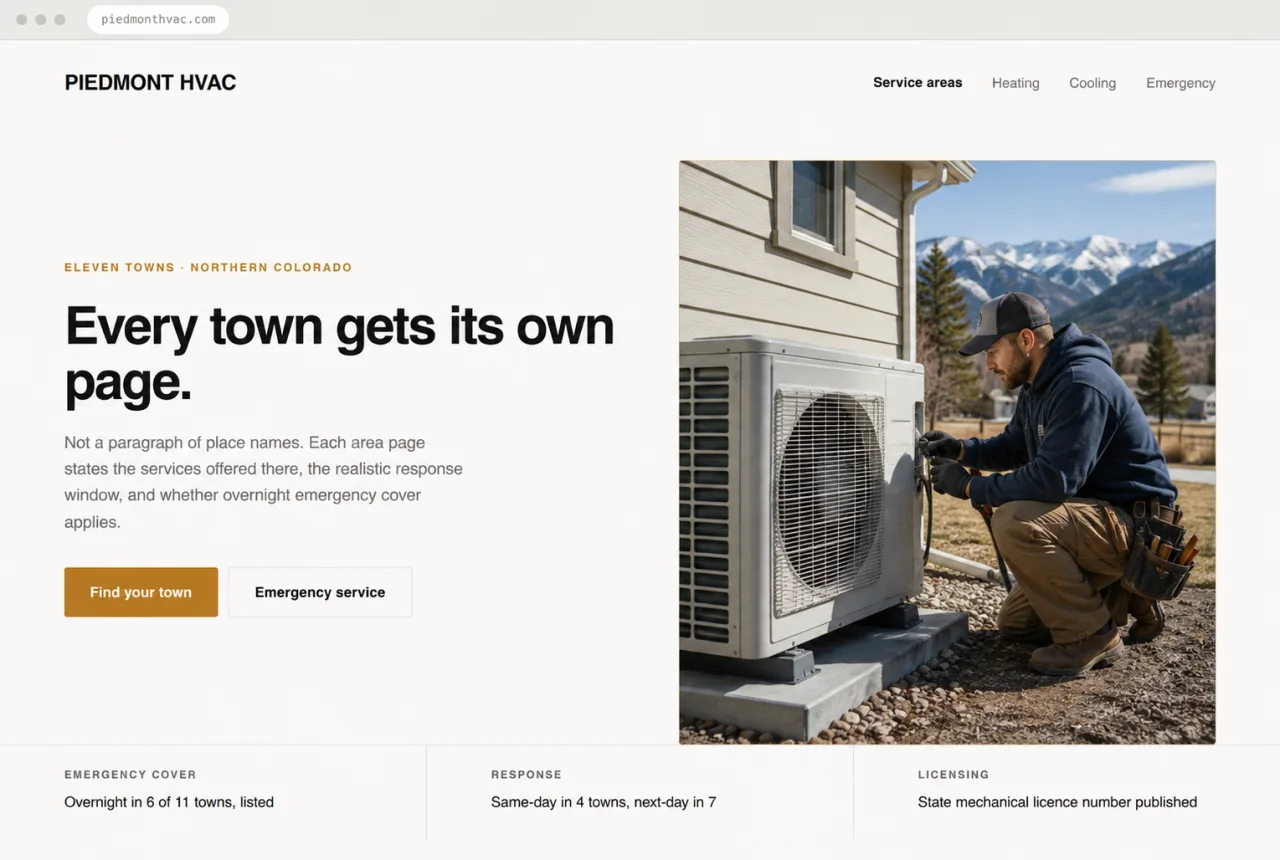
Design mockup of an HVAC contractor website with a technician servicing a heat pump, the headline “Every town gets its own page”, and visible emergency coverage and licensing details.
Hypothetical · HVAC contractor · eleven towns

Eleven towns, one page, no phone above the fold

A single “Areas We Serve” page listing eleven towns inside one paragraph. The phone number appeared once, rendered inside a footer image, so a caller on a phone had to scroll the whole page and retype it by hand. Overnight emergency cover — the firm's main advantage — was mentioned nowhere.

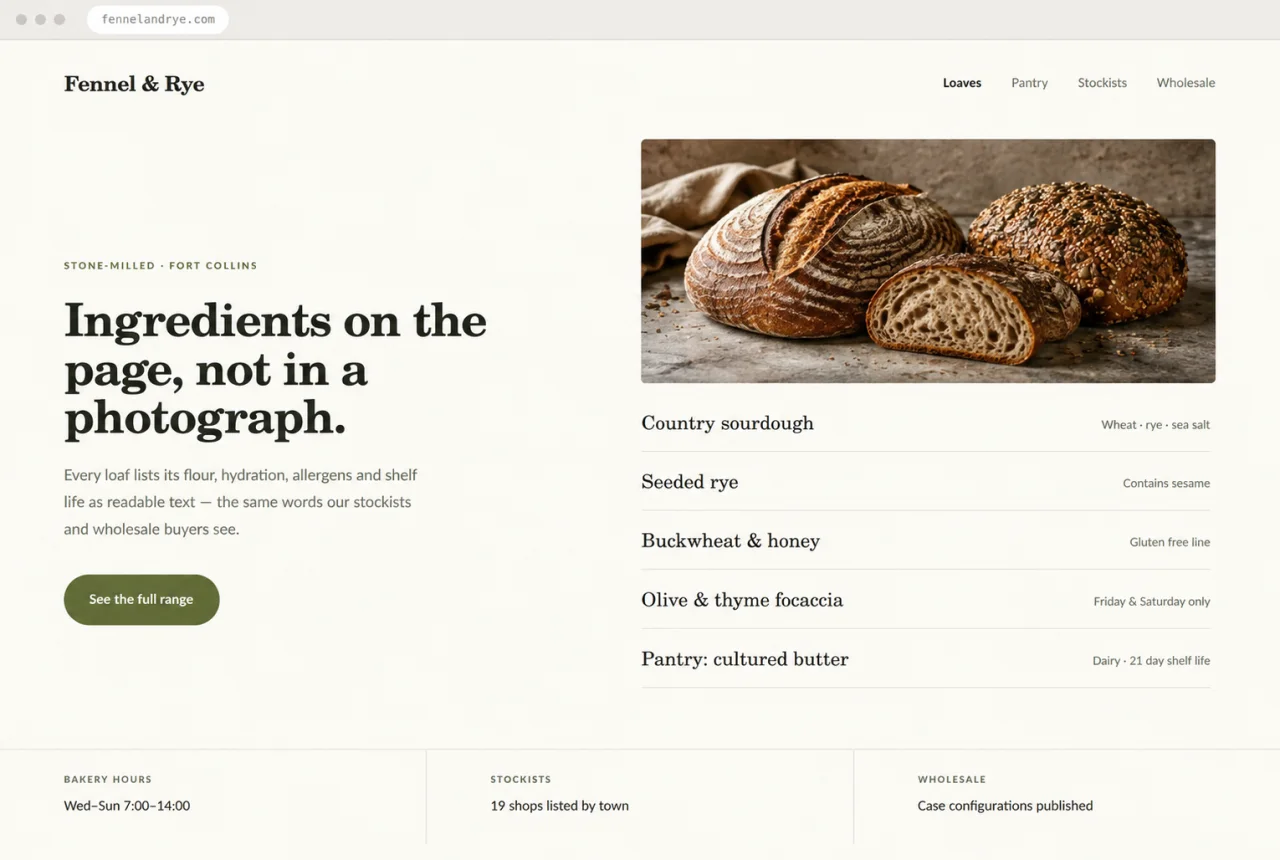
Design mockup of a bakery website with artisan sourdough loaves, the headline “Ingredients on the page, not in a photograph”, and a readable list of flours, allergens and stockists.
Hypothetical · Bakery and food producer

Allergens in three slightly different versions

Product descriptions, ingredients, allergen statements and sourcing existed only inside marketplace listings and a social profile, in three versions that did not match. The bakery's own domain redirected to the social page, so retail buyers looking the company up found nothing to point anyone at.

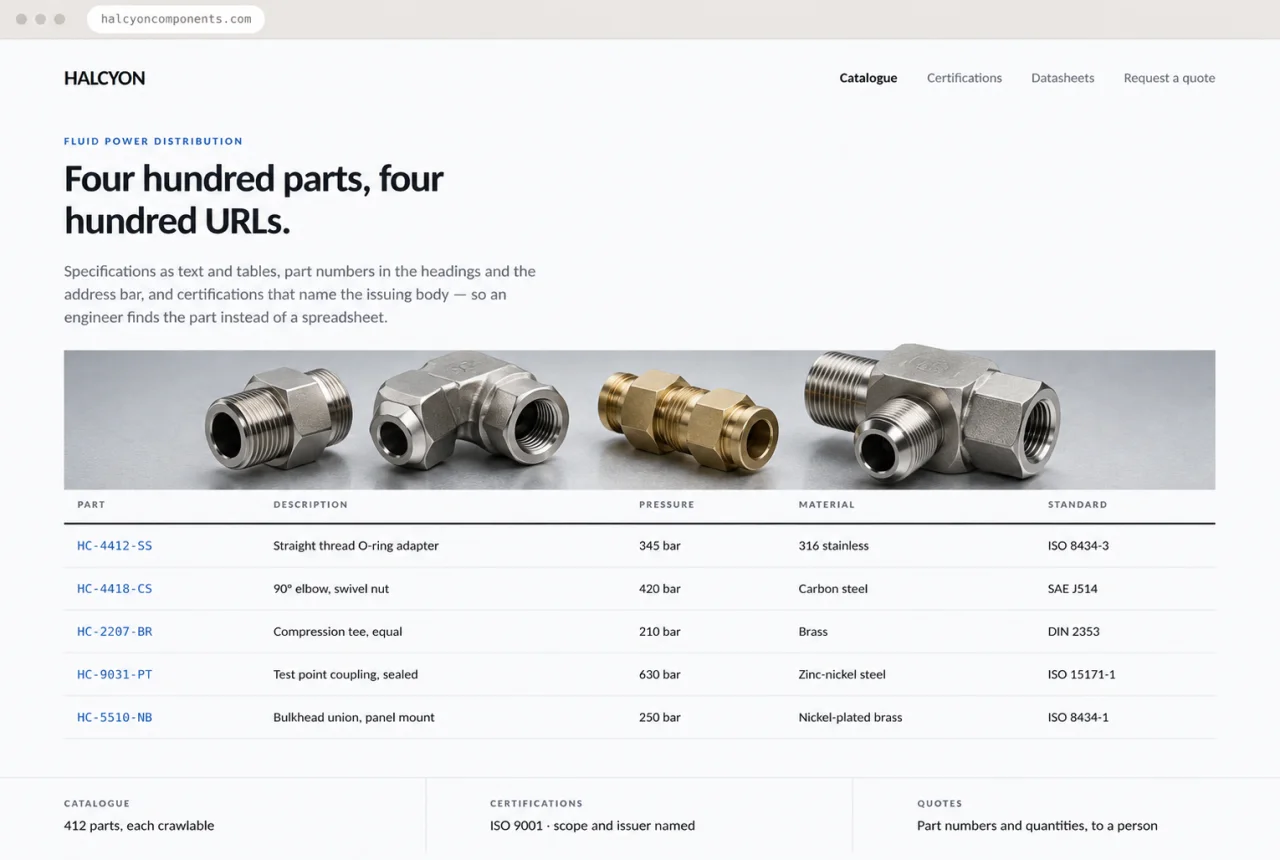
Design mockup of an industrial distributor website with machined fluid-power fittings, the headline “Four hundred parts, four hundred URLs”, and a specification table of part numbers and materials.
Hypothetical · B2B components distributor

A catalogue no system could read

Four hundred parts distributed as a downloadable spreadsheet, a single contact form as the only route to a quote, and certifications shown as logo images with the issuing body and scope written nowhere. An engineer searching a part number found nothing at all.

Fit

Who this is not for.

Saying so early saves everyone a month. If you recognise your project below, we will tell you at the review stage rather than after a deposit.

  • Anyone who wants a ranking guaranteed

    If the goal is a promise about position one, citations in AI answers, or a traffic number, we are the wrong studio. We will not make that promise and we do not compete with people who will.

  • Projects that need the cheapest possible site

    A template and an afternoon is a legitimate choice for some businesses. If that is the requirement, a builder subscription will serve you better than we will.

  • Businesses that cannot confirm their own facts

    We will not invent hours, credentials, service areas, certifications, or reviews to fill a page. If nobody can confirm what is true, the project cannot start.

  • Web applications and logged-in products

    Dashboards, marketplaces, member portals, and software with accounts and state. We build public sites. A product needs a product team.

  • Content that is designed to mislead

    Fabricated testimonials, invented addresses, markup that claims things the page does not say, doorway pages for towns you do not serve. All of it is a liability, and all of it eventually gets found.

  • Projects with no decision-maker

    If nobody can approve a scope, supply the facts, or answer a question inside a week, the schedule will not hold and neither of us will enjoy it.

Start here

Request a review.

Tell us three things and we will look at what you have: your current URL (or “no site”), your city, and what has to work on launch day.

You get back a written note on what we found — the specific problems, in priority order — and what it would take to fix them. If we are not the right studio for it, we will say that instead.

Prefer a faster answer? Message +1 (516) 888-0758 on WhatsApp, or write to zach@lizzianllc.com — either way, send the same three things.

We read every request and reply by email. We do not add you to a mailing list, and we do not share what you send. See our privacy notice.